
The Box That Never Stops
Twenty years of the FM3 Buddha Machine, from a temple shelf in China to sound-art collections around the world.
Sometime in the late 1980s, in a temple in Xiamen on China’s southeast coast, a young American musician noticed that the chanting filling the hall had no one chanting it. The sound came from a cheap machine looping a recording of prayer, over and over, for anyone who walked in. Christiaan Virant had grown up in Nebraska in the hardcore punk years of the early 1980s and had come to East Asia to learn traditional Chinese instruments. He didn’t know it yet, but he had just found the shape of the thing he would spend his life on.
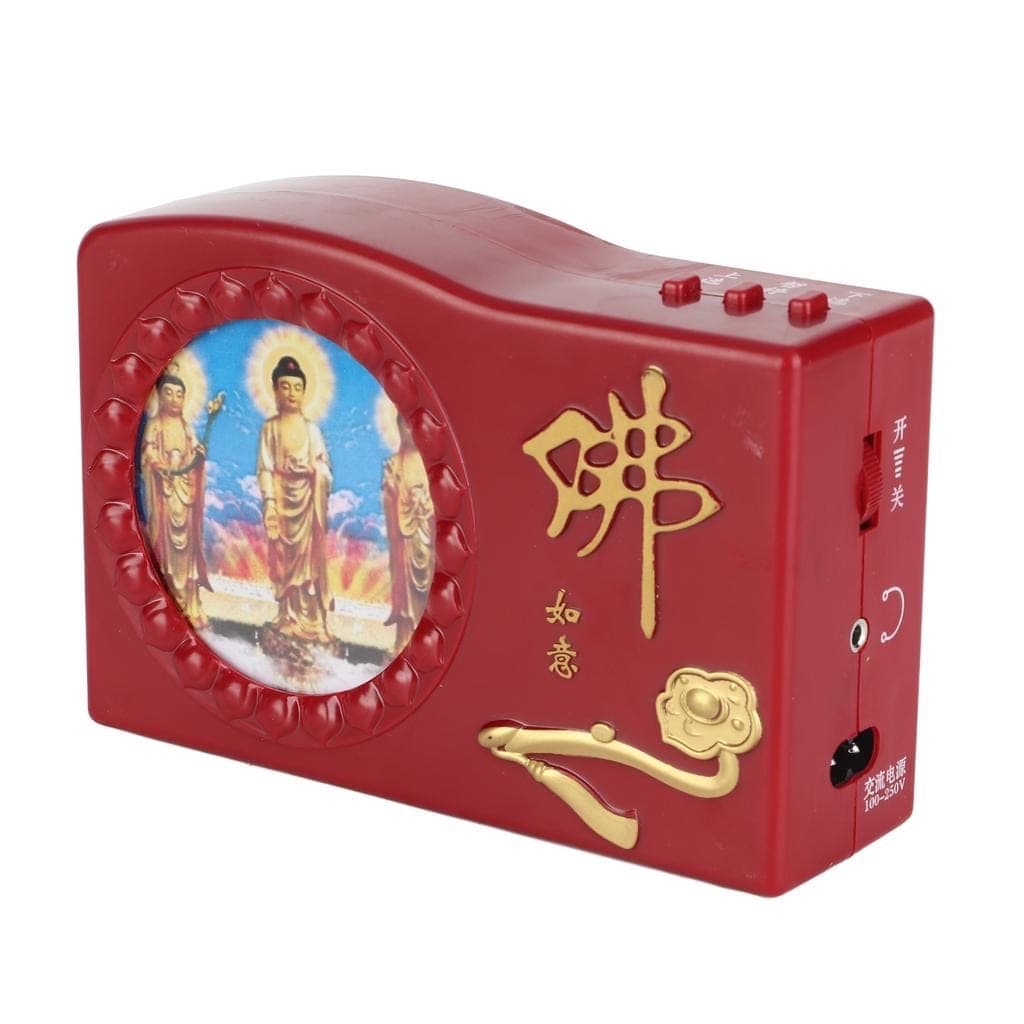
Once he started looking, the machines were everywhere. By the mid-1990s, near Mount Emei in Sichuan, he came across a digital version: a small plastic box about the size of a pack of cigarettes, with a speaker, a dial and a chip of looped chanting. Boxes like these were made in Taiwan and handed out to the faithful to spread the teaching. Nobody thought of them as music. Virant couldn’t stop thinking of them as exactly that.
In 1999 he formed FM3 in Beijing with Zhang Jian, a pianist from Chengdu who had left music school to work as a travelling musician. The city had almost no electronic music scene at the time. FM3 started out as a minimal techno project, but within a couple of years the beats fell away. What was left was slow, spacious music that set Chinese classical instruments against digital loops. They played the back rooms of Beijing clubs, and the rooms tended to go quiet.
Neither of them was Buddhist. What drew them to the chanting box was its design: a self-contained piece of sound that never ended and asked nothing of the listener. In 2004 they decided to make their own. They found a manufacturer willing to take on a small order that made little sense on paper. They cut the best few seconds out of their own recordings and loaded nine of them onto a chip. Virant later compared the process to pulling an espresso: “We take the best little bits of the songs and put it in the box.”
The loops ran from a second and a half to about forty seconds. The first run was a few hundred units, most of them for a record label and the rest for FM3’s own installations and gigs. They assumed it would last them a lifetime.
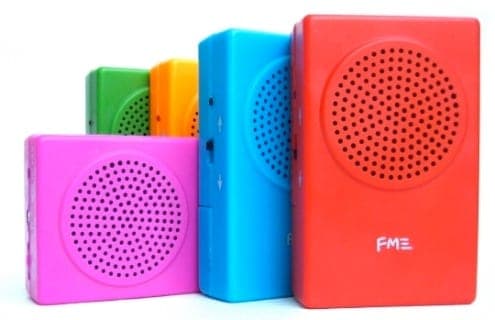
It lasted a matter of months. In March 2005 the first unit went to Brian Eno, whose tape-loop experiments had laid the groundwork for exactly this kind of music, and he soon wanted more. FM3 took boxes on tour and sold a handful at each show. Then the press caught on. The Wire wrote about the duo after seeing them perform with the devices in Berlin. The New York Times put the Buddha Machine on its list of the best boxed sets of 2005, an odd category for a plastic box with no discs in it, and orders surged. At the peak, FM3 was turning out around two thousand units a week, shipped from Hong Kong to record shops in the US, the UK and Japan. The original model went on to sell more than 100,000.
Part of the appeal was what the Buddha Machine refused to do. It arrived at the height of iPod mania, when the promise of technology was a thousand songs in your pocket. The Buddha Machine offered nine, and no way to add more. You switched it on, set the volume and let it play. Critics called it the anti-iPod. Listeners found the limits freeing.
Musicians found them useful. DJs ran several units through a mixer to fill the gaps in long sets. Artists placed dozens of boxes in one room and let the loops drift in and out of step, a sound installation running on AA batteries. In 2006 the remix album Jukebox Buddha gathered reworkings by Sunn O))), Blixa Bargeld, Tortoise and others, and Robert Henke built a whole album from the loops. Isaac Julien used FM3’s music in his 2010 installation Ten Thousand Waves, and David Byrne wrote about the box in How Music Works.
FM3 kept refining it. Buddha Machine 2 arrived in 2008 with nine new loops and a pitch control, which let listeners slow the sounds down or push them up. The third edition, Chan Fang (Zen Room), released in 2010, set the electronic drones aside for loops played on the guqin, the ancient Chinese zither. A fourth edition in 2012 came in a case that glowed under blacklight. Along the way came editions commissioned by the industrial pioneers Throbbing Gristle in 2009, the Japanese musician Cornelius in 2013, and Philip Glass, whose edition marked his 80th birthday in January 2017. In 2014 Virant brought the story to Bangkok, playing the EESE experimental music festival and leading a workshop on how the box came to be.
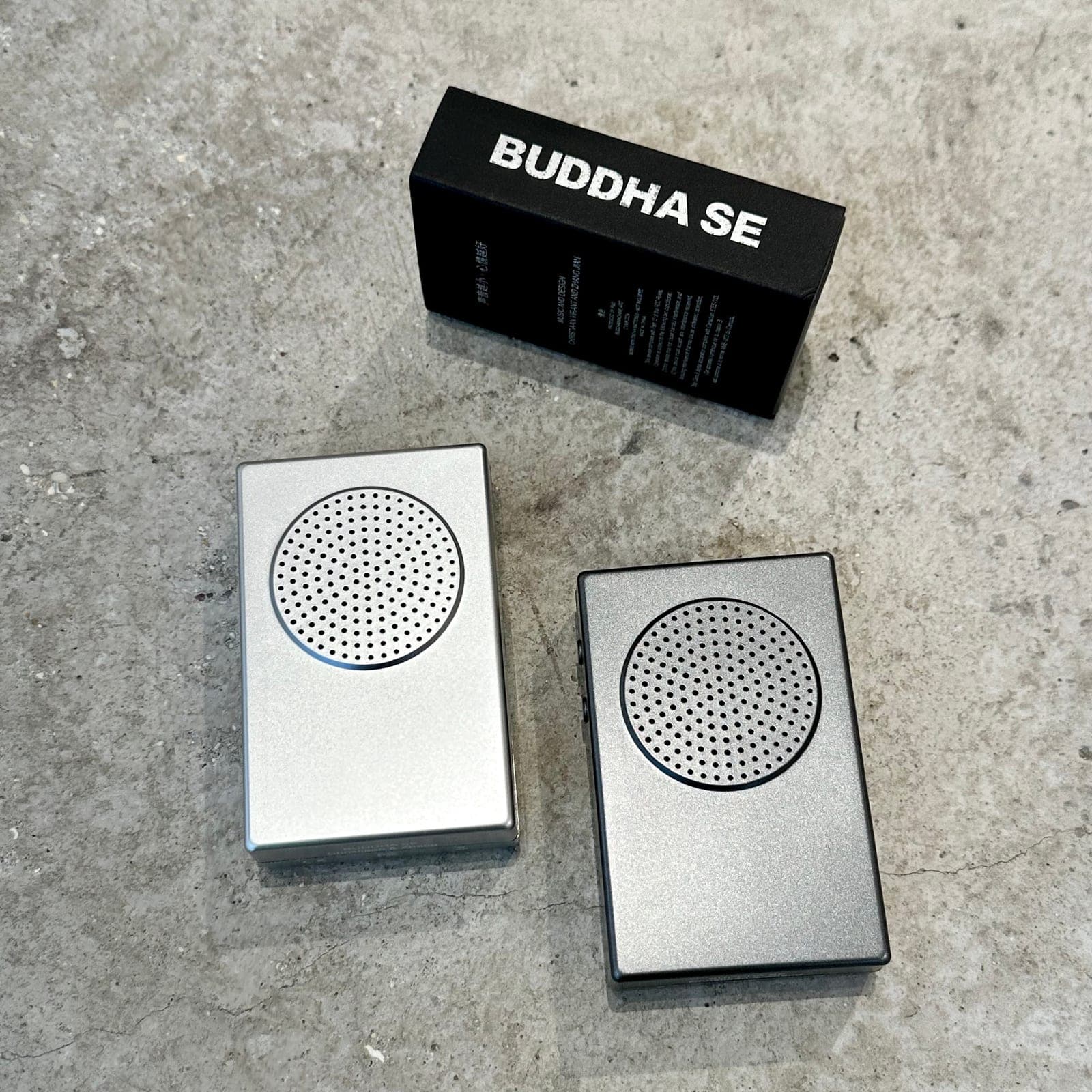
The pandemic nearly stopped everything. FM3 moved its studio from Beijing to Chengdu, and many of the small factories that supplied its parts closed for good. Getting production running again took about two years. When the Buddha Machine came back in a 2023 reissue of the original, it had a louder speaker, a softer, more tactile finish, and two side buttons in place of the old switch. The sounds were the same lo-fi loops as in 2005. A special edition in metallic silver and graphite followed in May 2024. In 2025 the Buddha Machine turned twenty, and a sixth edition, first planned for 2020, is still in the works.
Twenty years on, the idea hasn’t changed. A small box sits on a shelf, plays a few seconds of sound, and plays them again, for as long as you let it. In Thailand, ARTSELLAR imports the Buddha Machine directly from FM3.
Sources: Bandcamp Daily, O.cult (2025), South China Morning Post, The Wire, Wikipedia.